







Control systems – lighting control and management for commercial premises
Lighting control for retail, offices and industry
Lighting control does something different in each type of building. On a sales floor the subject is atmosphere and the rhythm of the day: the space has to read differently in the morning than in the evening, and differently again during deliveries. In offices, comfort and consumption come first – occupancy and daylight decide how much artificial light is needed at all. In industry and logistics, demand-based switching dominates: aisles, secondary areas and outdoor zones are lit only when someone is actually working or driving there. What all three have in common is that the saving comes from the usage pattern, not from the technology on its own.
Systems and protocols
The most widely used protocol in commercial installations is DALI: a digital bus in which every luminaire has its own address and can be controlled, dimmed and interrogated individually. DALI-2 improves interoperability between equipment from different manufacturers, and sensors and control devices are covered by the certification as well. Where tasks extend across the building – blinds, climate, access control – KNX comes into play, while simple applications are often served by a 1–10 V interface. In refurbishments without new control cabling, wireless components are the practical alternative. Whether a link to the building management system is worthwhile, and to what extent, is settled during the project.
Sensors: presence and daylight
Presence detectors switch or dim the lighting where people are present only intermittently: racking aisles, plant and ancillary rooms, washrooms, stairwells and car parks. The detection zone and the run-on time are what matter – set too short, switching disrupts operations; set too long, the saving is given away. We therefore select and position detectors according to the movement actually taking place in the area, not to a standard grid.
Daylight regulation controls luminaires in zones near windows and behind display windows so that they only supplement what already comes in from outside. It becomes worthwhile wherever long daytime operating hours coincide with a good supply of daylight.
Scenes for the sales floor
In retail, scene control follows the rhythm of the trading day. An opening-hours scene emphasises promotional areas and product presentation, an evening scene lowers the base level and shifts light onto accents, and a cleaning and restocking scene provides even working light without elaborate accentuation. Zones can also be switched separately – fresh food, checkout area and perimeter. Our retail lighting page describes how the installation has to be designed to support this.
Retrofitting while premises stay open
Control can be retrofitted in most existing buildings. The deciding factors are whether the installed luminaires are dimmable and whether control cabling is in place; where it is not, we use wireless components or combine the retrofit with a luminaire replacement that is due anyway. We work section by section so that trading or production continues. Existing time switches and legacy controls are either integrated or replaced outright – we avoid mixed operation with unclear responsibility.
Human centric lighting and emergency lighting monitoring
Control allows light colour and intensity to change through the day – from neutral white in the morning to warm white in the late afternoon. This matters most on floors with long occupancy and little daylight. Separately, emergency lighting can be brought into the monitoring system: function tests run automatically, and faults are reported and logged. Our emergency lighting page sets out the testing obligations that apply.
Control by building type

Supermarkets & food retail

Fashion & showrooms

Office buildings

Warehousing & production
Completed projects
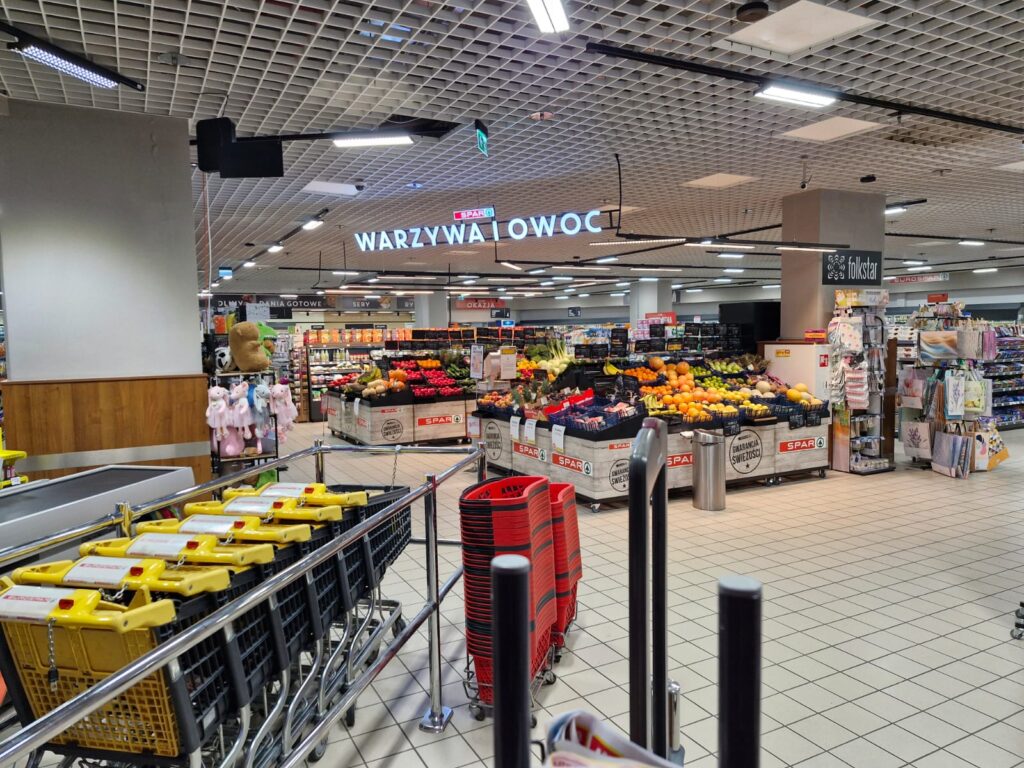 Spar
Spar





From analysis to commissioning
We start with an analysis of the spaces and requirements: how the areas are used, when they stand empty, where daylight reaches, and which luminaires and cabling already exist. From that we develop the control concept with zones, sensors, scenes and control points. Installation, parameter setting and commissioning follow; at the end we train your staff and hand over the system documentation. Where control is planned together with new lighting, both run as one project – see our lighting design service.
The three project phases
- Analysis of spaces and requirements: use, idle periods, daylight, existing luminaires and cabling
- Control concept with zones, sensors, scenes and control points
- Installation, parameter setting, commissioning, staff training and documentation
Working across Germany
AVA TECH delivers control projects throughout Germany. Our teams work regularly in Berlin, Munich, Hamburg, Cologne, Frankfurt am Main, Stuttgart and Düsseldorf, as well as at sites outside the major conurbations. Parameter setting and commissioning are carried out on site, as is staff training. For multi-site retailers we roll out a single, consistent operating concept across all branches.
Frequently asked questions
What is DALI and why is it used?
DALI is a digital bus system for lighting control. Every luminaire has its own address and can be switched, dimmed and interrogated individually, independently of how the power circuits are divided.
Can an existing installation be retrofitted?
In most cases, yes. It requires dimmable luminaires and suitable control cabling; where these are missing, we use wireless components or combine the retrofit with a luminaire replacement.
How much energy does lighting control save?
That depends on the usage pattern – operating hours, idle periods and the daylight share. We calculate the saving for your building rather than working with headline percentages, using the measured consumption of the existing installation as the baseline.
Can the system be linked to building management?
A link to BMS platforms is possible in principle; the scope and interface are agreed project by project.
Who sets up the scenes and trains the staff?
We do, at commissioning. You receive configured scenes, training on day-to-day operation and full documentation of the system.
You receive a control concept covering zones, functionality and operating logic, together with a transparent quotation – with no obligation.


